IRDAI's 2026 proposal to reshape insurance distribution: What buyers and distributors should know

On 23 September 2026, the Insurance Regulatory and Development Authority of India (IRDAI) released a consultation paper titled "Recalibrating Economics of Insurance Distribution".
The proposal could redraw how insurance policies get sold, priced, and rewarded.
The cost problem behind the reform
The regulator begins with a basic question. How much of each premium should fund claims, rather than the cost of doing business?
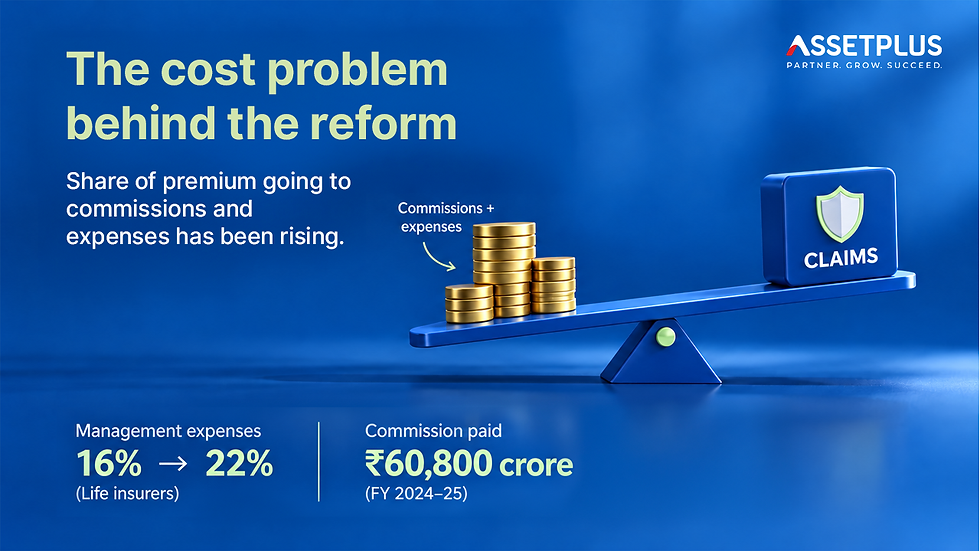
IRDAI Chairman Ajay Seth has flagged a steady rise in insurers' Expenses of Management (EoM), the money spent on running the business and selling policies. Life insurers' EoM has risen from around 16% in 2018-19 to about 22% today. For general insurers, it has moved from roughly 26% to 32% over six to seven years.
Commissions, meanwhile, have outpaced the underlying business. Life insurers paid close to ₹60,800 crore in commissions during 2024-25, a rise of about 18% in a single year. Total premium growth stayed far behind, at 6.73%. That widening gap sits at the heart of this new proposal.
Seth linked this to the single expense limit brought in during 2023. In his view, it encouraged commission-led growth instead of value for policyholders.
Coverage also remains thin. Insurance penetration sits at just 3.7% of Gross Domestic Product (GDP). The regulator believes lower distribution costs could help widen that reach over time.
The paper also revisits the overall EoM. It first changes the base of calculation. For general insurers, EoM would move to a new base: Gross Direct Premium Income (GDPI), not Gross Written Premium (GWP). Life insurers would measure it against total premium.
The limits would then tighten along a glide path, with annual reductions from FY2027-28. Life insurers would aim for 15% within two years and 12.5% within five. General insurers would target 25% within two years and 20% within five.
Life insurers already below the benchmark would move towards 10% over five years. Because the general insurance base changes, the current and proposed figures do not compare directly.
What the proposal is likely to change
The consultation paper is wide-ranging. It targets three areas at once: distribution structure, commissions, and forced bundling.
A simpler distribution structure
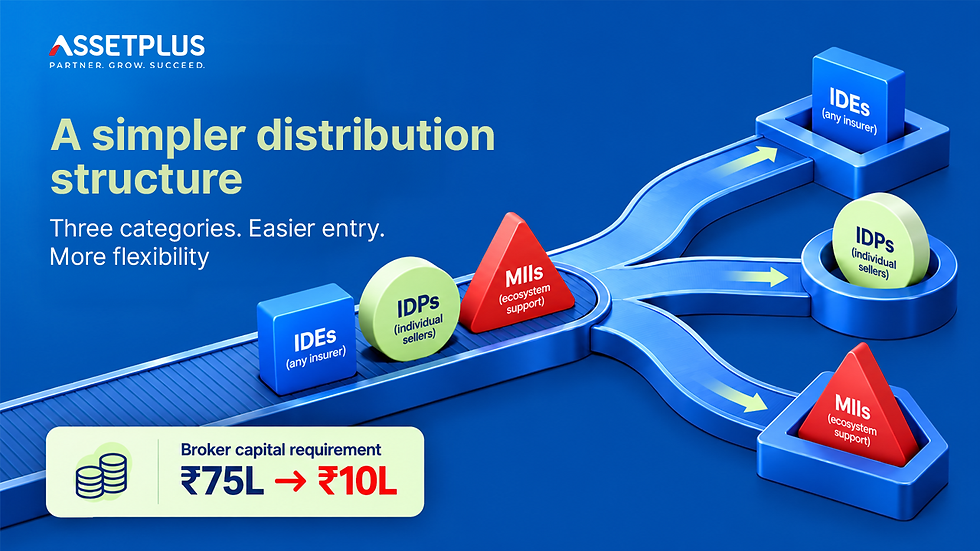
The paper proposes a cleaner architecture built on three categories:
Insurance Distribution Entities (IDEs), which can sell products from any insurer
Insurance Distribution Persons (IDPs), covering individual sellers
Market Infrastructure Institutions (MIIs), which support the wider ecosystem
The regulator also wants entry to become far easier. The broker capital requirement would fall from ₹75 lakh to ₹10 lakh. The annual fee would drop from ₹33,000 to ₹10,000. The regulatory fee would ease from five basis points to four.
IDEs could also offer approved non-insurance financial products. This gives distributors room to diversify their income.
Commission caps make a comeback
The most debated change concerns how much distributors earn. The paper revives product-level commission caps, reversing the single expense limit set in 2023.
These caps are tiered by product complexity and effort. Simpler products would carry lower payouts. Products that need more explanation at the point of sale would earn more. The ceiling now also absorbs technology, awareness, and promotional spend.
Key proposed commission caps
Life Insurance: First-year commission is tiered by premium payment term. Policies with a term below five years are capped at 5% for distribution entities and 6.25% for agents, rising through the tiers to 20% and 25% for terms of ten years and above. Individual pure term sold on multi-year premium sits outside this tier structure at 25% and 30%. Single-premium savings products fall to 1% and 2%, from today's typical range of around 2% to 11%. Regular-premium non-participating savings currently carry far higher effective payouts, between 29% and 60%, which the tiered caps would bring down.
Credit Life: Single-premium group credit-life commission proposed at 2% for distribution-cum-lending entities, versus effective payouts of around 45% today.
Health Insurance: Individual first-time sales capped at 15% for distribution entities and 20% for agents, with renewals and porting both capped at 5% for distribution entities and 10% for agents. Group health is capped at 2.5% for entities and 5% for agents, with a ceiling of ₹100 lakh.
Motor Insurance: For new vehicles, third-party commission is proposed at nil for distribution entities and 2.5% for agents. Own Damage, Personal Accident and Legal Liability covers are capped at 5% for entities and 10% for agents.
Individual policies sold in smaller towns and rural areas earn an uplift on the first-year commission: 10% of the applicable cap for towns under 10 lakh population, and 20% for small towns under 50,000 and rural areas.
Source: IRDAI's Recalibrating Economics of Insurance Distribution, Parts 1 and 2, September 23, 2026.
A short example shows the scale. Consider a regular-premium savings policy with a ₹50,000 first-year premium and a term above ten years. Such policies can carry effective payouts near 40% today, sending ₹20,000 towards distribution. Under the proposed 20% cap for that tier, the share falls to ₹10,000.
Moving to a system with more suitability checks
The reform also targets how policies get pushed onto buyers. Several proposals aim squarely at mis-selling.
Banks could no longer make a loan conditional on buying insurance. If a lender offers a cheaper rate with cover attached, it must display both rates openly. The customer would stay free to buy their insurance from any insurer.
The paper further seeks to curb volume-linked incentives for staff who sell insurance. It calls for clearer commission disclosures and action against manipulative online design. Together, these steps nudge the industry towards suitability checks rather than just sales volume.
What it means for buyers and distributors
The effects split across two groups, and the outcomes look very different.
For buyers, the promise is a fairer deal. Lower distribution costs create space to reduce premiums and improve transparency. Insurers face no compulsion to pass on the savings, so their response becomes the real test.
For insurance distributors, the pressure is immediate. Banks and online aggregators that lean on large upfront commissions face the sharpest adjustment. Traditional agents and dealer-linked motor sellers would also earn less per policy.
Markets reacted almost immediately. On 24 September, PB Fintech, the parent of Policybazaar, closed 36% lower on the National Stock Exchange (NSE), down from ₹1,886.30 to ₹1,207.20. Other insurers also came under pressure, with Max Financial Services falling 9.8%, HDFC Life 6.1% and ICICI Prudential Life 4.2% as investors assessed the potential impact of IRDAI's proposed commission and distribution reforms. (The Economic Times)
IRDAI has invited feedback from insurers, intermediaries and policyholders until 25 October 2026.
Buyers, meanwhile, can watch how premiums, disclosures and product design evolve in the months ahead. Anyone selling or buying insurance cover can read the full paper on IRDAI's official website (irdai.gov.in).
Frequently asked questions
1. What is IRDAI's new insurance distribution proposal?
It is a consultation paper titled "Recalibrating Economics of Insurance Distribution", released on 23 September 2026. It proposes capping commissions, simplifying distribution, and curbing forced insurance bundling with loans.
2. When would the new commission caps take effect?
Nothing is final yet. IRDAI is collecting stakeholder feedback until 25 October 2026, after which it will decide on the final rules.
3. Will insurance premiums become cheaper?
They could, since commissions are built into pricing. However, insurers are not required to pass on lower distribution costs to customers.
4. Who does the reform affect most?
Banks selling life insurance and online aggregators face the greatest pressure. Agents, brokers, and dealer-linked motor sellers would also see reduced payouts.
5. Can I still buy insurance through my current agent?
Yes. The proposal reshapes how much distributors earn, but it does not remove your choice of channel or agent.