The two maps every mutual fund distributor should be reading in FY26: where wealth sits, and where it's growing
- Marketing Team
- 8 hours ago
- 5 min read

Mumbai, Delhi and Bengaluru hold 50.4% of India's mutual fund assets, up from 45% a year ago. If you have built your practice around a metro client, the Association of Mutual Funds in India (AMFI) Annual Report for fiscal 2026 tells you that you were right. It also tells you that Dhanbad more than doubled its AUM in the same twelve months, and that seventeen cities you have probably never pitched in entered the top 110 for the first time.
Look closely at where India's mutual fund money is going, and you'll see two maps on the same page. One shows where the wealth sits today. The other shows where it is being made next. Most distributors only read the first one.
This piece walks you through both maps. Where the metros are pulling away, where smaller towns are quietly breaking out, and why the "shrinking tail" is misread. The map is not finished. Where you plant your practice next will decide what you build.
Where the wealth sits today
The stock map is the one everyone already reads. It concentrates a little harder every year.
The top is pulling away
That 50.4% is worth sitting with. As of March 2026, Mumbai alone commanded 28.97% of the ₹73.73 lakh crore industry base. New Delhi followed with 15.48%. Bengaluru added 5.92%. Widen the frame to five cities and the figure reaches 57.69%. (Source: AMFI Annual Report, Fiscal 2026).

To put that in plain terms: half of India's mutual fund wealth sits inside five postcodes.
What concentration is really telling you
Mumbai alone added roughly ₹5 lakh crore to its Assets Under Management (AUM) in a single year, which dwarfs the entire mutual fund base of most Indian states.
For a distributor, this creates an easy but flawed conclusion that if they chase the metros and match postcodes to wealth, their AUM jumps significantly. But geography is not destiny any longer. Your postcode should not be your ceiling.
Where the growth is actually moving
Turn to the second map. This is the one that rewards distributors who look early.
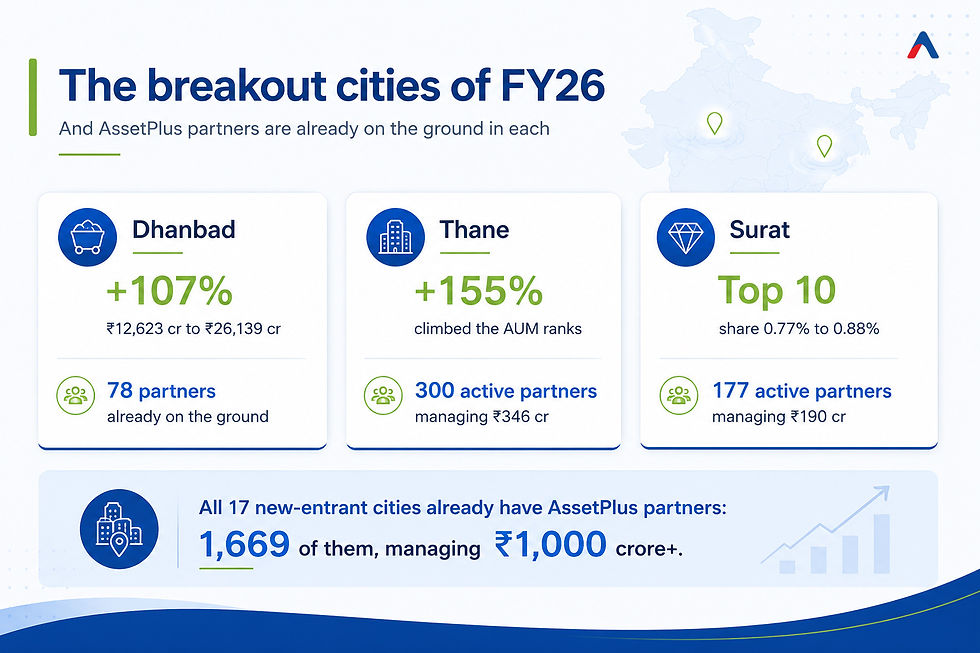
Fiscal 2026 saw sharp movement in India's next tier of cities. Cafemutual reports that Dhanbad (in Jharkhand) more than doubled its mutual fund AUM. It jumped from ₹12,623 crore to ₹26,139 crore, a 107% rise. Thane climbed 155%. Surat entered the top 10 for the first time, moving from 0.77% to 0.88% of national AUM. Seventeen new cities entered the top 110 ranked list).
Here is where the story sharpens. These emerging markets are exactly where AssetPlus already runs deep.
Our partner map corroborates this. As of July 2026, we have over 22,000 mutual fund distributors (MFDs) across 650 districts in India. In Thane, 300 of our active partners manage ₹346.34 crore in AUM. In Surat, 177 active partners manage ₹190.03 crore. And every single one of the 17 cities that entered AMFI's top 110 this year already has AssetPlus partners working in it. Across those 17 markets, 1,669 partners manage over ₹1,000 crore between them.
The tail that only looks like it is shrinking
The AMFI data has one number that spooks people. The "other cities" bucket, meaning everything outside the top 110, saw its share drop from 18.8% to 11.4%. That is roughly ₹34,402 crore that appears to have exited smaller India.
Except it did not exit. It graduated.

When cities like Dhanbad, Thane and Surat crossed into the top 110, their AUM moved with them. It shifted out of the "other cities" pool and into the ranked group. What looks like decline is actually movement upward.
Smaller India is not thinning. It is stepping into the light.
The opportunity hiding between the two maps
Put the two maps side by side, and the story becomes clear.
Wealth is concentrating in the metros. Growth is moving to the towns. The MFD who thrives this decade will serve both from the same seat.
In a recent LinkedIn post, our co-founder and Chief Executive Officer (CEO), Vishranth Suresh, made a related point. India has done an extraordinary job creating mutual fund awareness. Access has followed close behind. Yet neither is the same as wealth creation. His estimate: only 30 to 40% of India's 6 crore+ mutual fund investors invest with a real plan.
That gap is widest in the towns growing fastest. These are fresh investors starting their first systematic investment plans (SIPs). When markets fall, they need someone accessible who understands their situation and cultural context. That is the role a good MFD plays.
The map is not finished, and that works in your favour. Growth is still spreading outward, and mutual fund distributors who move early will capture it.
Where you build next matters more than where you stand today
The distributors who grow fastest this decade will not be the ones who started closest to the wealth. They will be the ones who reached new investors first. Fiscal 2026 shows where those investors are: the towns climbing the ranks, not the metros defending their lead.
Build where the map is heading, from wherever you are
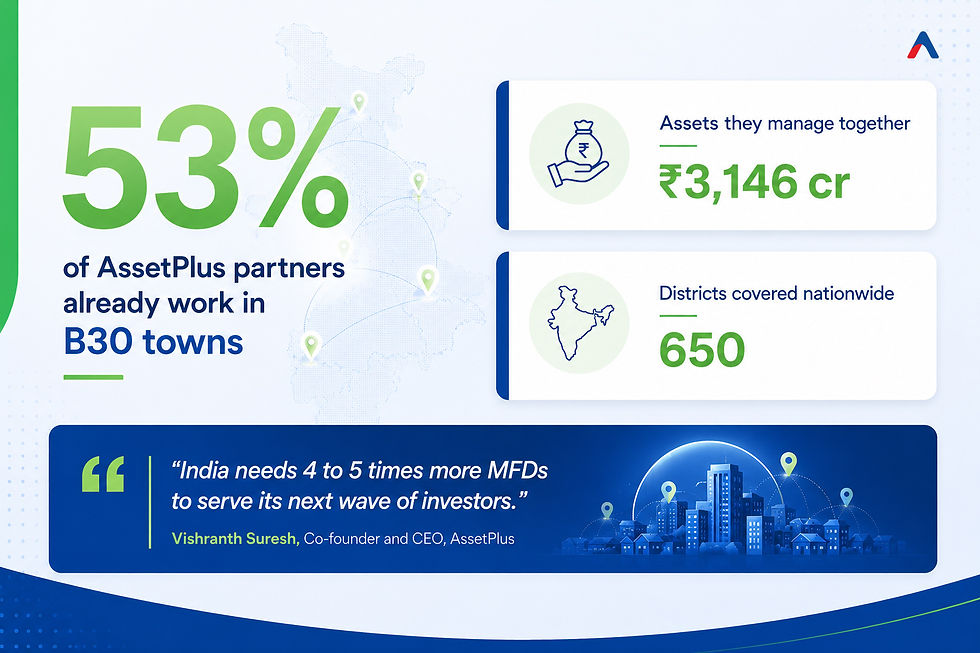
Today, 53% of AssetPlus partners already work in B30 towns. Together, they manage over ₹3,146 crore in AUM. That is not a target we are chasing. It is a movement already under way.
At AssetPlus, we are not here only to serve established MFDs. Our mission is to help every household in India empower itself by becoming one.
In the same LinkedIn post, Vishranth shared why. India needs four to five times more MFDs to serve its next wave of investors. That conviction shaped Har Ghar MFD, our movement to inspire ordinary Indians to become knowledgeable, capable distributors.
Our platform is built for exactly this shift. Onboarding takes minutes. Client-facing material, learning resources and portfolio tools sit in one place. Know Your Customer (KYC) checks that slow clients down elsewhere are quick and fully digital with us. You need a phone, an AMFI Registration Number (ARN) and the will to build.
Curious about Har Ghar MFD? Explore the Har Ghar MFD movement here.
Ready to become an MFD with us? Partner with AssetPlus today.
Frequently asked questions
1. Which cities hold the most mutual fund AUM in India?
As of March 2026, Mumbai holds 28.97% of India's mutual fund AUM, followed by New Delhi (15.48%) and Bengaluru (5.92%). Together with Pune and Kolkata, the top five cities account for 57.69% of the ₹73.73 lakh crore industry base (Source: AMFI Annual Report, Fiscal 2026).
2. How concentrated is India's mutual fund wealth?
Extremely concentrated at the top. Five cities hold more than half of all AUM. But 17 new cities entered the top 110 in FY26, which means the map is expanding outward at the same time it is concentrating at the top.
3. Which smaller cities grew fastest in FY26?
Dhanbad more than doubled its AUM, growing 107%. Thane climbed 155%, and Surat entered the top 10 for the first time. Seventeen cities entered the top 110 for the first time, led by names like Dhanbad, Thane and Surat. (Source: Cafemutual).
4. Is mutual fund investing really declining in smaller towns?
No. This is the most common misread of the FY26 data. The "other cities" share dropped because many towns graduated into the top 110. Their AUM moved up the ranking, not out of the market.
5. How can someone from a small town become a mutual fund distributor?
Any Indian resident who clears the National Institute of Securities Markets (NISM) Series V-A certification and holds an ARN can distribute mutual funds. AssetPlus Academy offers structured training to help you pass the NISM Series V-A exam. Once certified, the AssetPlus platform lets you onboard clients, manage portfolios and track reports from anywhere.
6. What is Har Ghar MFD?
Har Ghar MFD is an AssetPlus initiative to grow India's community of mutual fund distributors. It aims to inspire more people to become MFDs, build awareness of the profession, and equip them with the knowledge and tools to succeed. The belief behind it is simple: more capable MFDs help more Indian families invest with a plan and build lasting wealth.


