Best strategies to increase MFD commission income in 2026

Key takeaways
SEBI's Mutual Funds Regulations, 2026 (effective 1 April 2026) delinked GST from commission and restructured exit loads, compressing payouts for many distributors.
Trail commission, paid out monthly on the AUM you manage, remains the most reliable driver of long-term MFD earnings, not one-off client acquisitions.
Diversifying across hybrid, debt, SIF, goal-based, and health insurance-linked offerings protects commission and deepens client relationships.
SIP top-ups and step-ups grow trail income at almost no extra acquisition cost.
SEBI's B-30 and women investor incentive, effective March 2026, adds 1% of the first application amount, capped at ₹2,000, as extra commission.
Reducing attrition and adopting the right technology platform have become decisive factors in protecting commission through this regulatory shift.
AssetPlus partners have seen commission reductions of under 10%, well below the 20%-plus hit reported industry-wide.

You open your July brokerage statement expecting the usual number. Instead, your commission on the same asset under management (AUM) is lower than in June. No client left you. There was no market crash. Yet the payout shrank. If this happened to you, you are not imagining it, and you are far from alone.
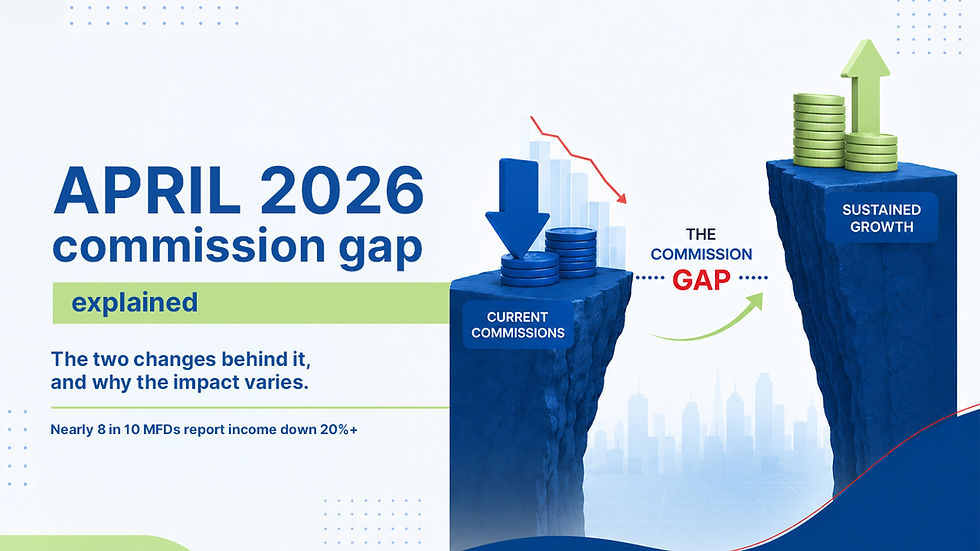
SEBI's revised expense ratio framework, effective 1 April 2026, has reshaped how commissions are calculated industry-wide. A June 2026 Cafemutual survey found nearly 8 in 10 MFDs saw income fall by more than 20% once the new rules kicked in.
This blog sets out five practical strategies to increase MFD commission, strengthen your trail income, and build a business that grows steadily.
We also break down what the new TER regulations mean for your mutual fund commission and how your platform choice can soften the blow considerably.
Why trail income is your real foundation
Trail commission is the backbone of a sustainable distribution business. Unlike one-time upfront payouts, trail income compounds as your AUM grows and stays invested.
Systematic Investment Plan (SIP) contributions reached ₹30,954 crore in May 2026, up 16% year-on-year, and SIP assets now account close to 21% of total industry AUM. Every rupee that stays invested through a SIP compounds your trail book at no extra acquisition cost.
Yet many distributors chase new clients while underinvesting in existing ones. A client retained for a decade generates far more lifetime commission than three who redeem within two years. Therefore, protecting and growing your trail book is the single most reliable lever for higher MFD earnings.
Five ways to increase MFD commission in 2026
Here is where to focus your energy and how to execute on each front.
Strategy 1: Diversify beyond vanilla equity SIPs
Relying solely on equity SIPs limits your earning potential and exposes your book to market cycles. Expand into categories that serve different client needs and often carry distinct commission structures.
Hybrid and debt funds appeal to conservative investors and add stability to your AUM during volatile phases.
Health insurance add-ons give clients a financial cushion during medical emergencies, so they don't need to pause SIPs or redeem investments to cover costs. Positioning insurance alongside mutual funds protects your client's goals and your trail book at the same time.
Specialised Investment Funds (SIFs), a newer category bridging mutual funds and portfolio management services, are gaining traction with a ₹10 lakh entry point.
Goal-based planning products, including retirement and children's education funds, tend to see longer holding periods, which strengthens trail continuity.
A diversified book protects your mutual fund commission even when one asset class underperforms. It also positions you as a financial expert rather than a product pusher, which builds deeper client trust.
Strategy 2: Deepen SIP books through top-ups and step-ups
Acquiring a new SIP client costs time and effort. Growing an existing SIP requires less effort, yet directly lifts your trail income.
Encourage clients to increase their SIP amount annually, in line with salary increments. A modest 10% step-up each year compounds meaningfully over a decade. Similarly, prompt clients with surplus funds to make lump-sum top-ups into existing schemes rather than opening fresh, smaller investments elsewhere.
This approach works because it strengthens relationships you have already built. It also reduces the SIP stoppage ratio within your book, a metric that has climbed industry-wide in recent months.
Growing what you have, not just chasing volume, remains an underused way to increase MFD commission.
Strategy 3: Navigate the new SEBI TER regulations proactively
SEBI's Mutual Funds Regulations, 2026, took effect on 1 April 2026, and two changes within it are directly compressing distributor payouts.
GST is now delinked from commission. AMCs quote commission on a GST-exclusive basis, and the GST component reaches only GST-registered MFDs after invoice submission. Unregistered MFDs lose that portion entirely, an effective cut of roughly 8 to 12 bps.
Exit loads no longer fund distributor payouts as they once did. With exit loads restructured at the scheme level, the pool AMCs draw from to pay commissions has shrunk further, trimming another 4 to 7 basis points on average.
Combined, a typical non-GST-registered MFD working directly with AMCs has seen commission fall from around 80 basis points to between 60 and 70. On ₹10 crore AUM, that is ₹9,000 to ₹17,000 lost monthly.
This compression, though, is not uniform. It depends heavily on how your platform is structured.
AssetPlus took two decisions ahead of this change. We credit your GST component the same day as your brokerage, on the 20th of every month, so you never wait weeks for money that is already yours.
And our combined scale across AMCs has held our exit-load-related reduction to roughly 3 to 5 basis points, well below the industry average.
The result: More than 80% of AssetPlus partners experienced commission reductions of less than 10%, far lower than the 20%-plus hit reported industry-wide.
The way to protect your commission is not to resist this shift, but to get ahead of it.
Distributors who understand these regulations well ahead of clients will consistently retain an advisory edge.
Also read: Your GST, credited the same day as your brokerage, and The April 2026 commission gap, explained.
Strategy 4: Tap into SEBI's B-30 and women investor incentives
Effective February 2026, SEBI's revised incentive framework offers additional commission, over and above regular trail, for onboarding new investors from B-30 cities and new women investors. You earn 1% of the first application amount, capped at ₹2,000, on both lump-sum and SIP investments, provided the investor stays invested for a year.
This is a meaningful opportunity if your practice reaches smaller towns or has not actively targeted women investors so far. It rewards genuine outreach rather than existing metro relationships, making it one of the more accessible ways to boost near-term MFD earnings.
Strategy 5: Reduce attrition and scale with the right technology
Every redemption chips away at your trail book, and attrition, more than acquisition, decides your long-term commission stability. Protecting it and running a leaner operation come down to the same habit: staying ahead of problems instead of reacting to them.
Build a structured review cadence, half-yearly check-ins, prompt responses during volatility, and clear communication before clients start asking questions. Clients who understand why they are invested rarely panic-redeem.
Our AI Assist tool, rolled out to AssetPlus partners, reviews portfolio health and concentration risk across client accounts, flagging when a client is overweight in one sector or fund before it becomes a retention issue.
Internal polling at our Partner Prestige events found 82% of participating partners already use AI heavily in daily work, a sign this kind of proactive review is fast becoming standard practice.
The same discipline extends to your operations. Manual reconciliation across AMC logins eats hours better spent on these conversations. With paperless onboarding completed in under three minutes, automated brokerage reconciliation, and real-time AUM tracking across all AMCs, AssetPlus partners spend less time on admin and more time growing their trail book.
Today, over 22,500 MFDs manage more than ₹9,000 crore in assets and a monthly SIP book exceeding ₹145 crore through our platform, proof that retention and technology reinforce each other.
Building consistent MFD earnings from here
Higher commission rarely comes from one big move. It comes from steady SIP growth, lower attrition, smart diversification, and staying ahead of regulatory shifts like the new TER framework. The distributors who combine these habits with the right platform tend to build the most resilient books.
Grow your MFD business with the right partner
AssetPlus provides end-to-end business solutions for MFDs, from paperless onboarding and automated brokerage tracking to research and marketing support, so you can focus entirely on growing your AUM and your MFD earnings.
If you are ready to build a steadier income stream, empanel with AssetPlus and explore what our platform can do for your practice.
Frequently asked questions
What is trail commission in mutual funds?
Trail commission is a recurring payout that distributors earn every month, calculated as a percentage of the AUM they manage, for as long as the client stays invested.
How does SEBI's 2026 TER regulation affect MFD commission?
It separates statutory levies from the base expense ratio and tightens brokerage caps, which may pressure AMC margins and eventually influence distributor payouts.
Can MFDs still earn upfront commission?
No. Upfront commission on mutual funds has been banned since 2018. Distributors primarily earn through trail commission, along with select regulatory incentives.
What is the fastest way to increase MFD commission this year?
Growing your existing SIP book through top-ups, reducing redemptions, and tapping SEBI's B-30 and women investor incentives typically show the quickest results.
Does my platform affect how much of the TER cut I absorb?
Yes, significantly. Platforms like AssetPlus offer GST-same-day crediting and scale-based AMC negotiations, showing far smaller reductions than direct AMC arrangements.